
Blog · 8 November 2026 · 3 min read
A Nail In Your Tyre: What To Do, And The One Thing Not To Do
Leave it in. Why pulling a nail out is the mistake that turns a ten-minute repair into a flat, how to tell a slow puncture from a fast one, and what gets repaired.
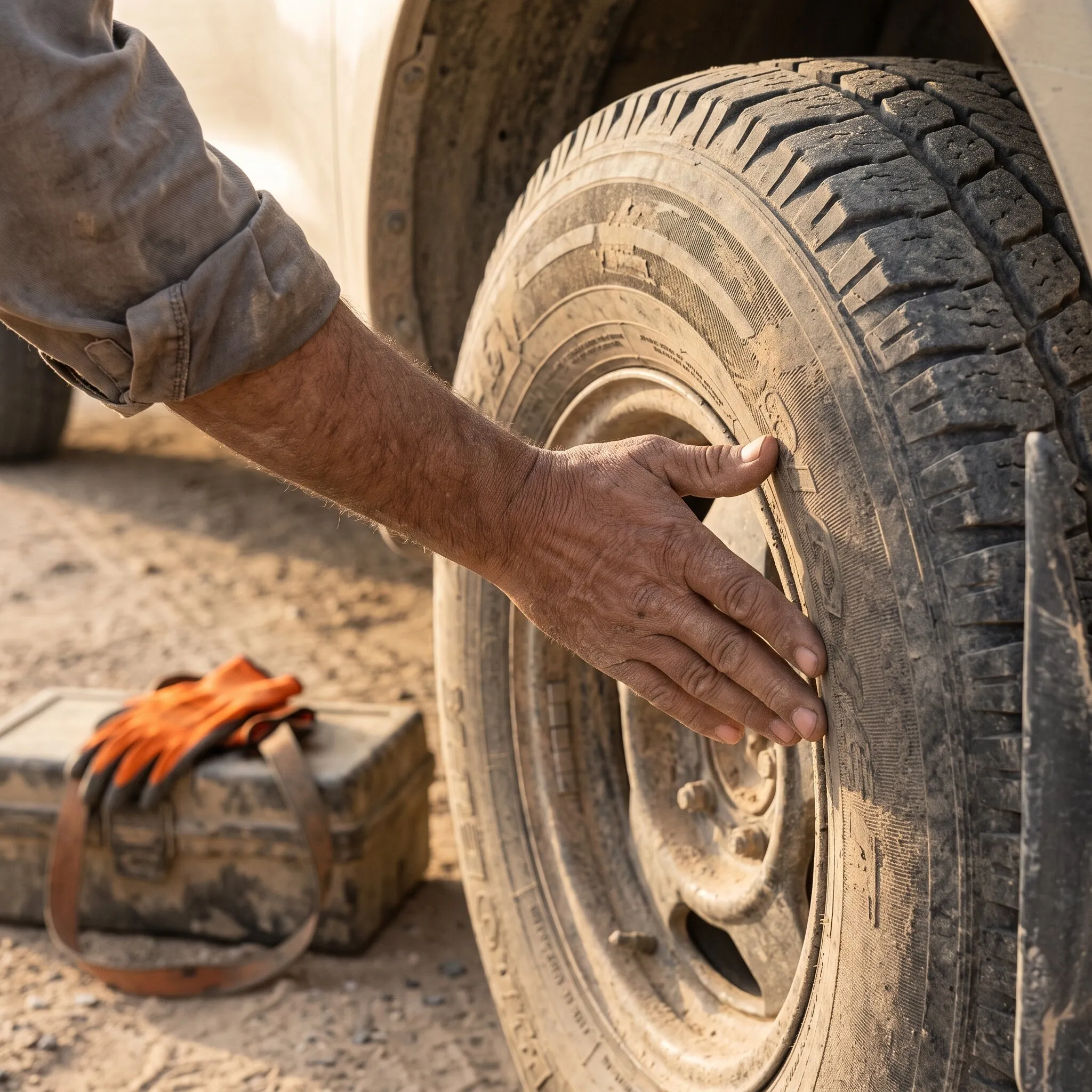
You have spotted the head of a nail or a screw in your tyre. The tyre may still be holding air, or the pressure warning light may already be on. What you do in the next few minutes decides whether this is a quick inside repair or a new tyre, so here is the order, starting with the one mistake to avoid.
Do not pull it out
The nail is currently the plug. While it is in the hole the air is leaking slowly around its shaft, which is why many people drive for days before they notice. Pull it out and the tyre goes down in seconds, often where you least want it to. It also makes the technician's job harder: a nail in place shows exactly where the hole is and at what angle it went in, which is what decides whether the tyre can be repaired. Leave it alone and let us remove it with the tyre off the rim.
Check the pressure, then decide
If the tyre looks normal and the pressure is close to the others, you have a slow puncture. Drive gently to the nearest safe place to stop or, if you are near home or work, to where the car can stand. Do not head out on Sheikh Zayed Road to find a shop; a slow puncture can become a fast one when the nail shifts at speed.
If the tyre is visibly soft or the car pulls to one side, stop as soon as it is safe. A tyre driven flat for even a few hundred metres is usually destroyed inside however good it looks, and that turns a repair into a replacement.
What can be repaired
A nail in the central tread of the tyre is the most repairable puncture there is. The rules we work to at the car:
- Where: in the tread, away from the shoulder where the tread curves into the sidewall. A nail in the sidewall or the shoulder cannot be repaired safely by anyone; that tyre is a replacement.
- How big: up to about 6 mm across, which covers nearly every nail and screw. A bolt or a piece of steel that has torn the tyre is a different conversation.
- What else: enough tread left to be worth repairing, and no sign that the tyre has been run flat. We check the inside of the tyre for that, because it does not show from outside.
If the puncture passes those checks, the tyre comes off the rim and a patch-plug is fitted from the inside: the stem fills the hole and the patch seals the liner. It is the same vulcanized repair a good workshop does, done at your location, and the tyre is good for the rest of its life. Our repair or replace post has the reasoning behind each rule.
About sealant kits: if your car came with a can of sealant instead of a spare, it will get you to safety, but the sealant coats the inside of the tyre and has to be cleaned out before a proper repair, and it can ruin the pressure sensor in the wheel. Use it when you have to, not as a repair.
The pressure light came on but I cannot see anything
That is still most likely a nail or a screw, sitting between the tread blocks where the head is hard to see, or a nail that has already fallen out and left the hole behind it. A soapy-water spray over the tread will show it as a stream of bubbles. If one tyre needs topping up noticeably more often than the others, treat it as a slow puncture and have it looked at before it chooses its own moment.
What to send us
Your location, a photo of the nail if you can see it, and a photo of the sidewall so we can read the size and come with a matching tyre in case the puncture turns out to be beyond repair. We come to cars and SUVs anywhere in Dubai, around the clock, with the price agreed before we start. Details on the puncture repair near me page, numbers below.